Use case
One source of error are repetitive tasks, e.g. when creating the same issues over and over again.
Use the following use case to create an issue in the current project and set a summary and a description. Save time and get started!
🛠️ Configuration
Add a Create issue post function to the workflow transition you want.
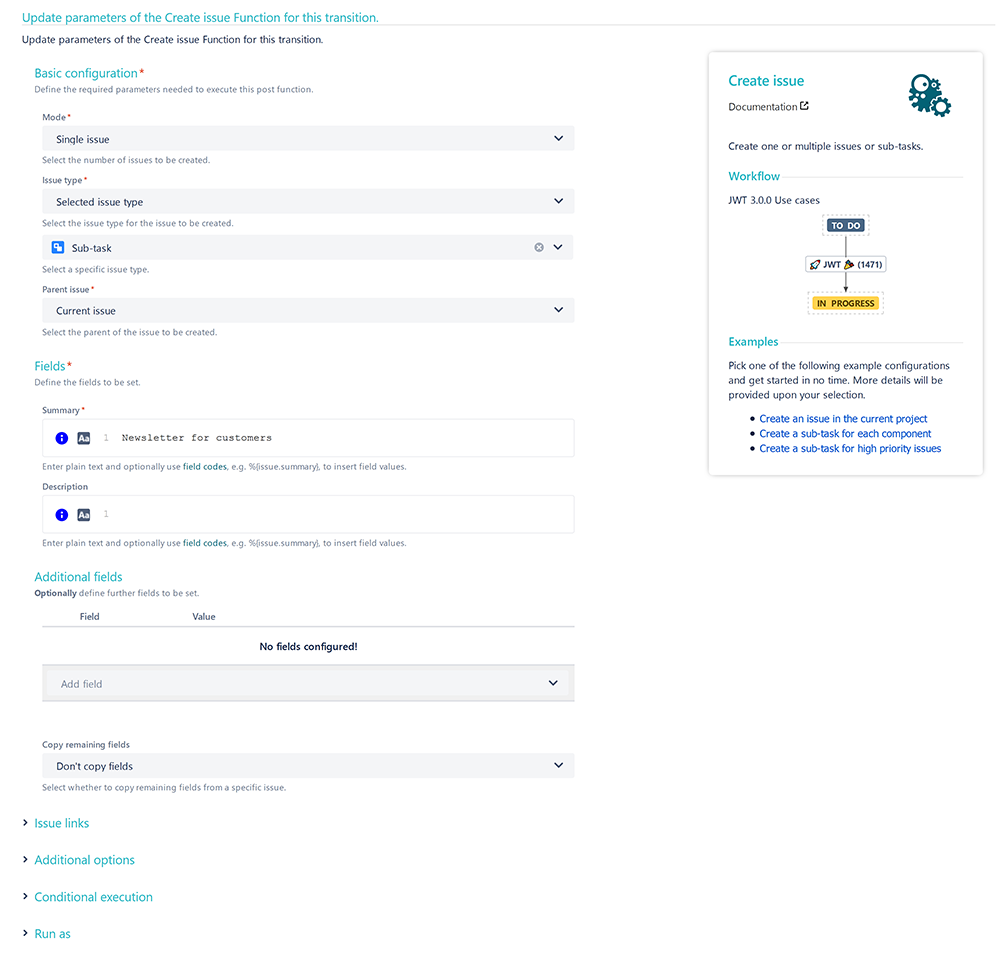
Issues to be created
Mode
Choose Single issue
Issue type
Choose Selected issue type → Sub-task
Parent issue
Choose Current issue
Summary
Enter a summary according to your needs, like
Newsletter for customers
Description
To enrich the issue with further information, you might want to add a short description. It is not mandatory, though.
Further configuration
Fields
You have the possibility to set additional fields on the issue to be created.
Maybe you want to predefine the issue Assignee or a time estimation for time logging purposes.
Don't want to set the fields? You can also copy existing values from the current issue!
For further information, you might want to take a look at the Create issue documentation.
Issue links
This is an optional parameter where you can define issue links for the issue to be created.
Additional options
If you want to copy issue keys of created issues into the field Temporaty Text 3 as a text list, choose this option.
Conditional execution
If you want some conditions that need to be checked before the execution of this post function, add your logical expression.
Uncertain about this part? See JWT expression editor
Run as
Select which user will be used to execute this post function. By default this parameter is set to the current user. You can also use field codes to run the function as a dynamic user (e.g. current assignee).
Make sure that the user running the post function has all the relevant permissions to perform the actions defined in the configuration (e.g. "Update Issues")!
If you want to keep track the actions being performed automatically, we suggest to create a dedicated JWT account, granted all relevant permissions, and use it in the Run as parameter to identify which changes have been made with JWT.
📷 Screenshots