
JWT is a powerful tool that can handle a lot of your Jira data! However, on large instances, JWT can have an impact on the overall performance, especially when performing complex or unoptimized calculations.
To stay on top of Jira's performance, you can easily restrict JWT's CPU and memory usage! Since 3.1.4
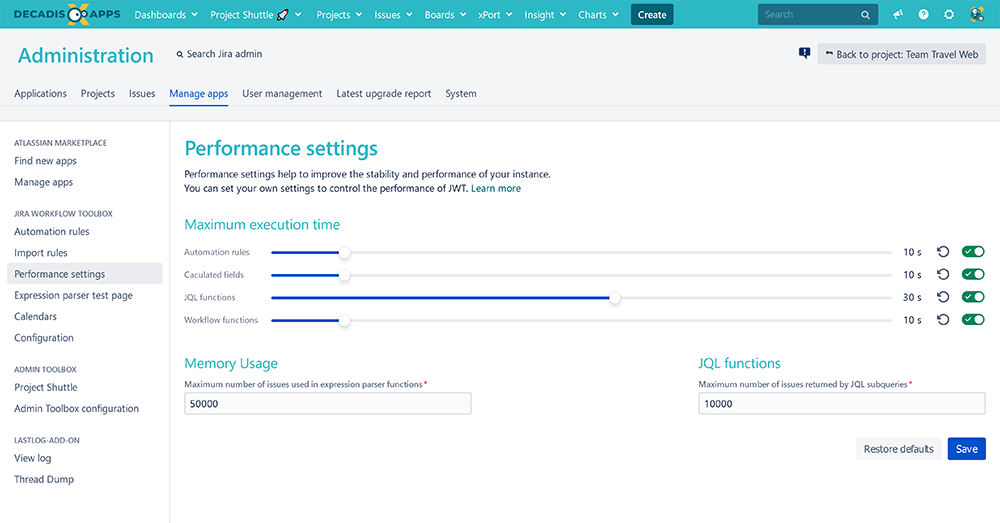
Maximum execution time
You can define the maximum execution time of each JWT area individually.
All values are in seconds. If a calculation takes longer as the specified value, the below written rules will apply.
You can also disable the execution limit for each part. If you do so, you might experience performance issues! It is therefore not recommended to turn off the execution limits!
|
Area |
Default value |
Configuration |
|---|---|---|
|
Automation rules |
10s |
If the underlying calculation for a rule
it will abort the whole calculation without returning a result and an error will be thrown. Information about the error will be written to the Jira log. |
|
Calculated fields |
10s |
If the underlying calculation for a field
it will abort the whole calculation without returning a result and an error will be thrown. Information about the error will be written to the Jira log. |
|
JQL functions |
10s |
If the underlying calculation for a JQL function
it will abort the calculation. Only issues calculated at this point will be returned. In addition, an error will be displayed in the issue navigator. Information about the error will be written to the Jira log. |
|
Workflow functions |
10s |
If the underlying calculation for a workflow function (condition, validator, post function)
it will abort the whole calculation without returning a result and an error will be thrown. Information about the error will be written to the Jira log. |
Memory usage
In addition to time limits, you can define the number of issues that should be processed in a single calculation.
In order to save resources, you can set a limit for issues to be processed in a single parser function.
The default value is 50.000.
JQL functions
Used for JWT JQL functions where you can define a JQL subquery, such as:
Setting a limit will only limit the number of issues returned by the subquery, not by entire JQL function itself.
The default value is 1.000.