
All issues
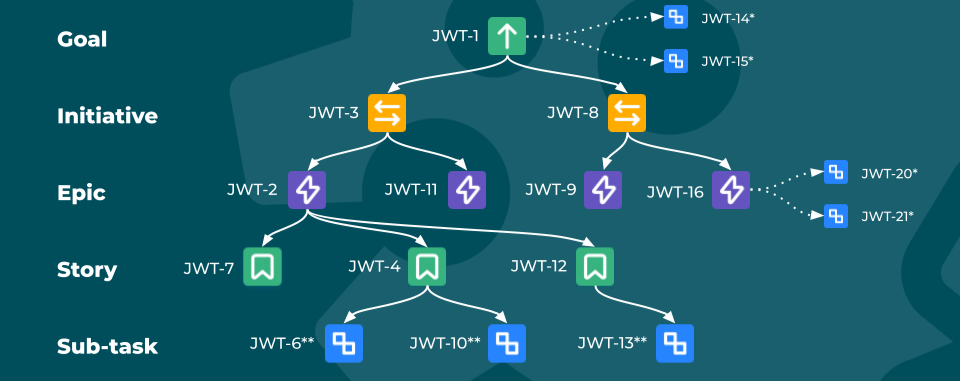
This function returns a list of all descendant issues, meaning all issues located at any level below the current issue in the configured Jira Cloud issue hierarchy.
The hierarchy includes:
-
Issues linked via the Parent Link field
-
Issues linked through Epic-Story relationships
-
Sub-tasks at the lowest level of the hierarchy
This function allows you to retrieve all child, grandchild, and deeper-level issues according to the hierarchy defined.
allIssuesUnder() #Output: Issue list
Examples
|
Parser expression |
Description |
|---|---|
|
Bash
|
Considering that current issue is JWT-3, this expression returns all issues in any level below it: JWT-2, JWT-11, JWT-7, JWT-4, JWT-12, JWT-6, JWT-10, JWT-13 |
Output
This function returns an ISSUE list
Issue list
Variant where you additionally define issues.
Duplicated issues are filtered from the output.
allIssuesUnder(issueList) #Output: Issue list
Examples
|
Parser expression |
Description |
|---|---|
|
Bash
|
Assuming that expression JWT-6, JWT-10, JWT-9, JWT-16 To achieve this the following functions are used: |
Additional information
Parameters used in this function
|
Parameter |
Input (data type) |
Description |
|---|---|---|
|
|
ISSUE LIST |
Any given issue list. |
Output
This function returns an ISSUE list
Issue keys
Variant where you define issue keys instead.
Duplicated issues are filtered from the output.
allIssuesUnder(issueKeys) #Output: Issue list
Examples
|
Parser expression |
Description |
|---|---|
|
Bash
|
This example returns all issues in any level below issues JWT-3 and JWT-8:
|
Additional information
Parameters used in this function
|
Parameter |
Input (data type) |
Description |
|---|---|---|
|
|
TEXT |
A text containing issue keys separated by commas. |
Output
This function returns an issue list